
Montgomery County Criminal Court Cases
Montgomery County Superior Court is the felony trial court and part of the six-county Oconee Judicial Circuit. Its clerk manages criminal and juvenile court records, collections, jury administration, docket entries, judgments, and permanently kept case files. The clerk's counter is at 400 South Railroad Avenue in Mount Vernon. It is open Monday through Friday from 8:30 a.m. to 5:00 p.m., including lunch, and can be reached at 912-583-4401.
Magistrate Court shares the street address but keeps a different record layer. It executes arrest and search warrants, holds first appearances and bond hearings six days each week, and conducts preliminary hearings. A recent event may exist there before the district attorney files a Superior Court case. Some ordinance, bad-check, alcohol, litter, noise, and animal-control matters also remain within the court's stated functions. Staff can explain access and procedure but cannot give legal advice or privately discuss a pending case.
Montgomery Clerk Counter at Lunch
The Superior Court clerk's open-during-lunch schedule is useful when an online court search does not show the needed document. Visit the official Montgomery County clerk page before travel, or call to ask whether public-terminal inspection is available. Mail requests go to P.O. Box 311, Mount Vernon, GA 30445; the published fax is 912-583-4343.
Clerk of Superior Court
400 South Railroad Avenue
Mount Vernon, GA 30445
912-583-4401
Monday-Friday, 8:30 a.m.-5:00 p.m.
Ask about the current per-page and certification charges before sending payment because Montgomery County has not published a criminal-copy fee schedule. The clerk is the authoritative source for certified judgments and older or absent electronic files.
Note: The Superior and Magistrate counters share a street address and fax, but their mailing addresses and court records differ.
Searching Montgomery County Case Records
The Judicial Council's E-Access Court Records directory lists Montgomery Superior Court and routes users to PeachCourt. PeachCourt requires an account, and its login wall prevented confirmation of Montgomery County search fields, archive dates, result columns, document fees, and sample criminal cases. Treat the field list below as information to prepare, not as a claim about the portal's exact screen.
- Open the state directory and follow its Montgomery Superior Court link to PeachCourt account access.
- Sign in or register, then look for the Superior Court matter by defendant name or case number.
- Use aliases, filing year, and an approximate arrest or filing date to separate similar names.
- Record the case number, status, and available docket entries. Do not treat a charge label as the final result.
- Contact the clerk for certified copies, authoritative verification, older files, or a record that PeachCourt does not expose.
| Field Label | Type | Required | Notes |
|---|---|---|---|
| Defendant name or aliases | Text | Practical minimum | Use full spelling and known variants. |
| Date of birth | Date | May be restricted | Helps separate same-name people. |
| Case number | Text | No, but best | Directs the clerk to one file. |
| Arrest or incident date | Date range | No | Useful for recent or unfiled events. |
| Court and document type | Request | Yes conceptually | Specify Superior or Magistrate and the record needed. |
PeachCourt Is Not the Courthouse
Montgomery County's state-listed route is PeachCourt, even though other Georgia courts use re:SearchGA. The PeachCourt homepage advertises Georgia civil and criminal electronic filing, while Georgia Courts marks Montgomery Superior e-filing mandatory. Neither fact proves that every historic case or every public document is remotely searchable.
The official court-directory image below shows why the statewide directory should be the starting point instead of assuming one portal serves every county.
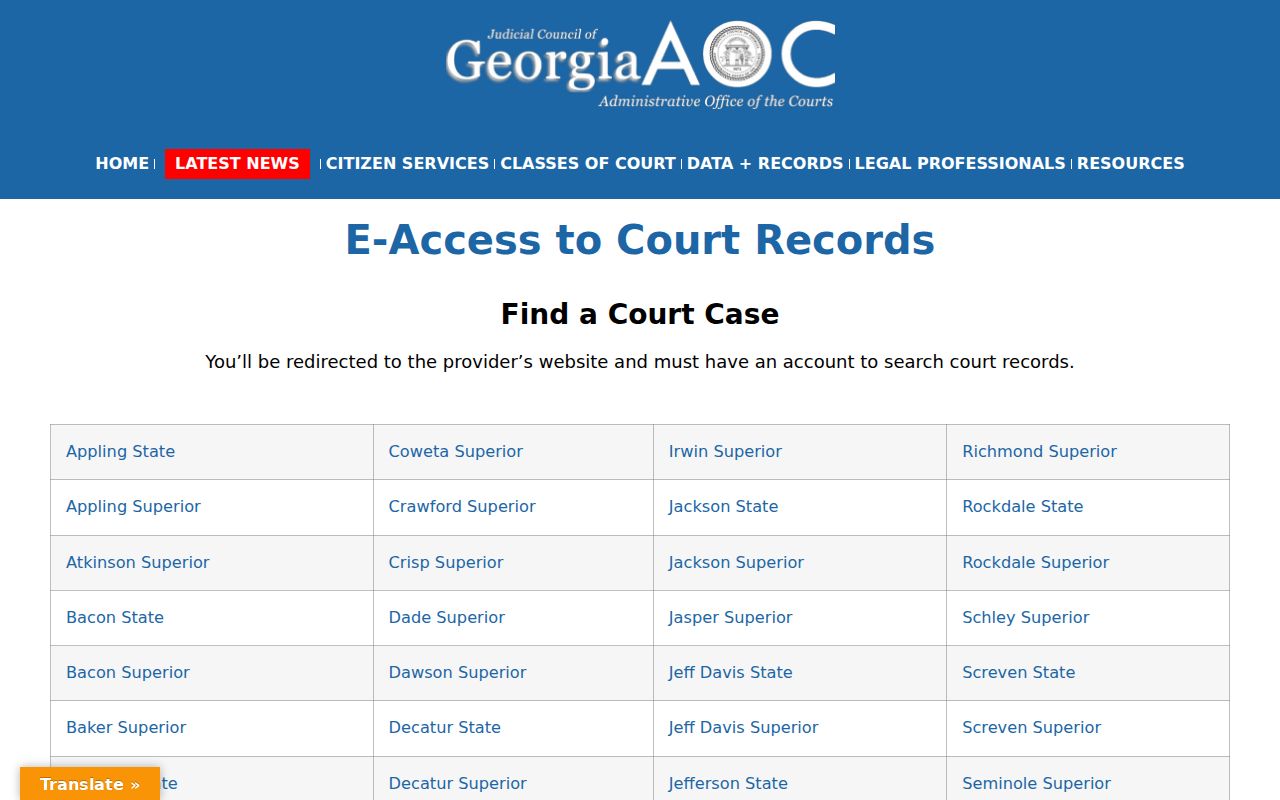
Use the directory route first, then confirm any missing record with the Montgomery County clerk rather than concluding that no case exists.
The re:SearchGA image documents a separate Georgia court-search channel, but the Judicial Council directs Montgomery users elsewhere.
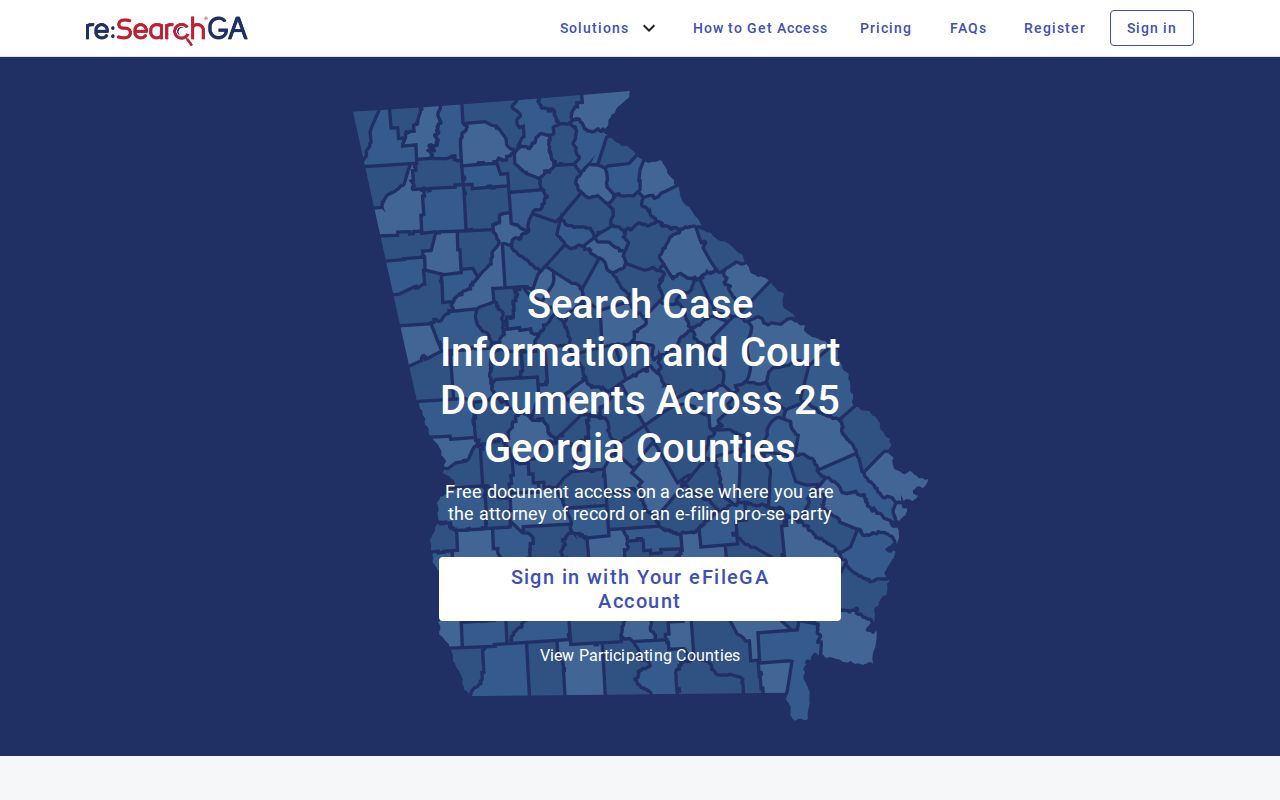
This distinction matters for a reliable Montgomery County case lookup: portal coverage and court custody are not the same thing.
Inside a Montgomery County Case File
A criminal case file may show the allegation at filing, later amendments, hearings, orders, and the final judgment. The docket gives the event sequence, while the signed disposition or judgment supplies the most reliable outcome. A GCIC history adds fingerprint-linked arrest cycles and reported dispositions, but reporting gaps can leave the court file more current.
| Case number and court | Identifies the file, filing court, year, and often case status. |
|---|---|
| Charging document | Shows an accusation or indictment and any original or amended counts. |
| Docket entries | Chronicle filings, hearings, motions, orders, and notices. |
| Bond and hearings | May show bond terms, arraignment, motion dates, and trial settings. |
| Disposition and judgment | Records plea, verdict, dismissal, or other adjudication and its date. |
| Sentence and conditions | May list confinement, probation, fines, restitution, or later revocation activity. |
Sensitive exhibits, victim identifiers, juvenile information, and sealed material may be withheld. A displayed financial balance should not be assumed current for payment without clerk confirmation.
Missing Montgomery County Dispositions
An arrest can reach GCIC through fingerprints before the matching prosecutor or court disposition arrives. Georgia Felon Search's official FAQ says a conviction may be absent because court information has not been sent or remains in processing. That gap does not change the Montgomery County judgment.
If your own history is incomplete, identify the arrest cycle and obtain a certified disposition from the Superior Court clerk before starting a GCIC challenge.
GCIC's personal inspection route is better suited to identity errors or missing cycles than a name-only public result. For rap-sheet interpretation, the official FAQ lists 404-244-2639, option 5, on weekdays from 9:00 a.m. to 2:00 p.m.
Note: A blank portal result can reflect coverage, timing, spelling, restriction, or court choice rather than proof that no record exists.
How a Criminal Case Moves
Montgomery Magistrate Court may issue or execute the warrant, conduct the first appearance, address bond, and hold a preliminary hearing. The district attorney then decides what to prosecute, and a felony case moves into Superior Court through accusation or indictment. Later docket events can include arraignment, motions, plea or trial, judgment, sentence, probation orders, revocation proceedings, and appeal notices.
Montgomery County case flow: Warrant or probable cause › Arrest and booking › First appearance and bond › Prosecutor review › Accusation or indictment › Arraignment › Plea or trial › Judgment and sentence.
No official Montgomery County source supplies fixed completion times for each stage. Use the docket for actual dates, and remember that release on bond is a custody event rather than a case disposition.
Records Before a Felony Filing
Magistrate Court creates a distinct record trail before a Superior Court felony file exists. Its official Montgomery County description says it executes warrants for the sheriff, Mount Vernon Police Department, GBI, State Patrol, DNR, and the Department of Driver Services. Warrant execution is available around the clock, while public counter hours are weekdays from 8:30 a.m. to 5:00 p.m.
- First appearance
- The initial court stage addressing custody, rights, and related matters after arrest.
- Bond hearing
- A proceeding about release conditions, not a finding of guilt.
- Preliminary hearing
- An early probable-cause stage that may occur before felony filing.
Call Magistrate Court at 912-583-2170 for its records. For a filed felony judgment, move to the Superior clerk instead.
Federal Cases Beyond Montgomery County
Montgomery County lies in the Southern District of Georgia. Federal criminal dockets use PACER, not PeachCourt. PACER registration is free, but generated searches and documents follow the federal fee schedule. Certified federal records come from the federal clerk, and sealed documents remain unavailable.
The official PACER image below represents the separate federal channel for a Montgomery County-related prosecution.
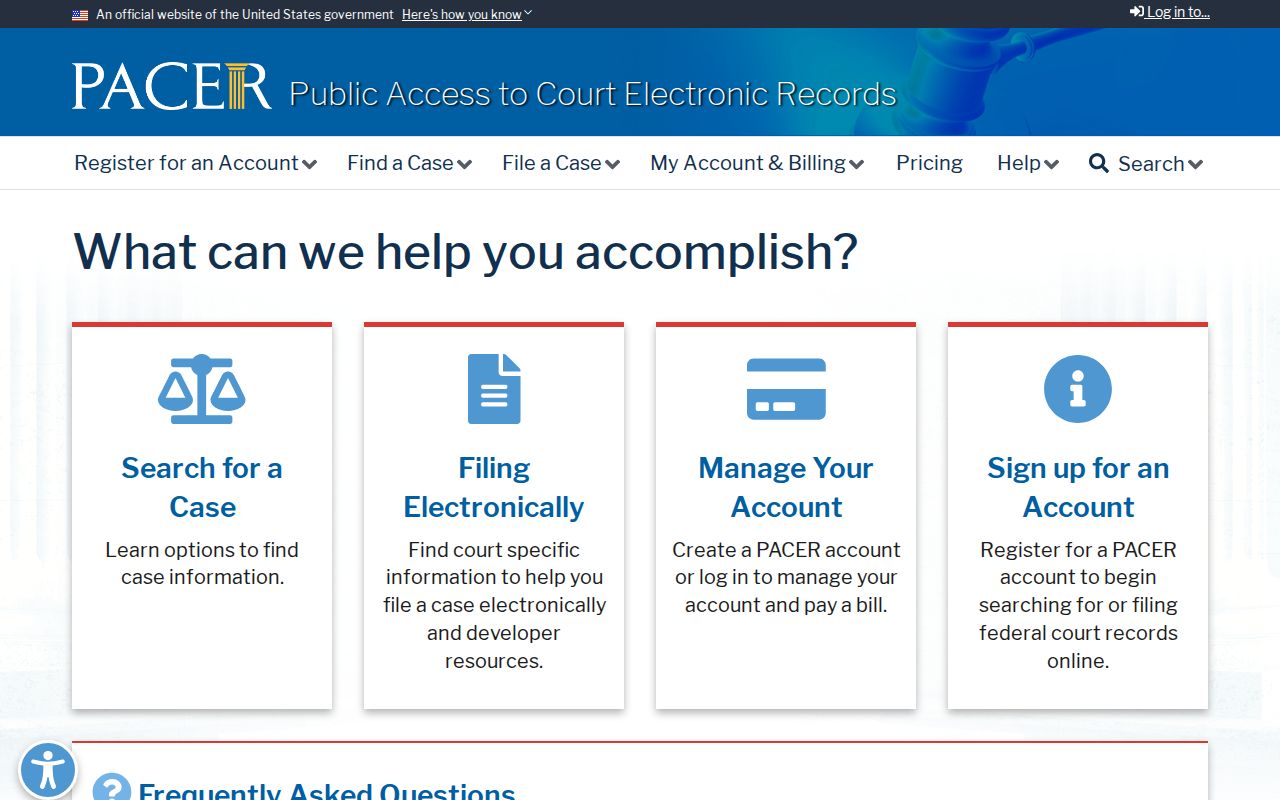
A county clerk search cannot locate a Southern District indictment, and PACER does not replace Montgomery Superior Court records.
The Oconee Judicial Circuit public defender page is another official source for the circuit serving Montgomery County.
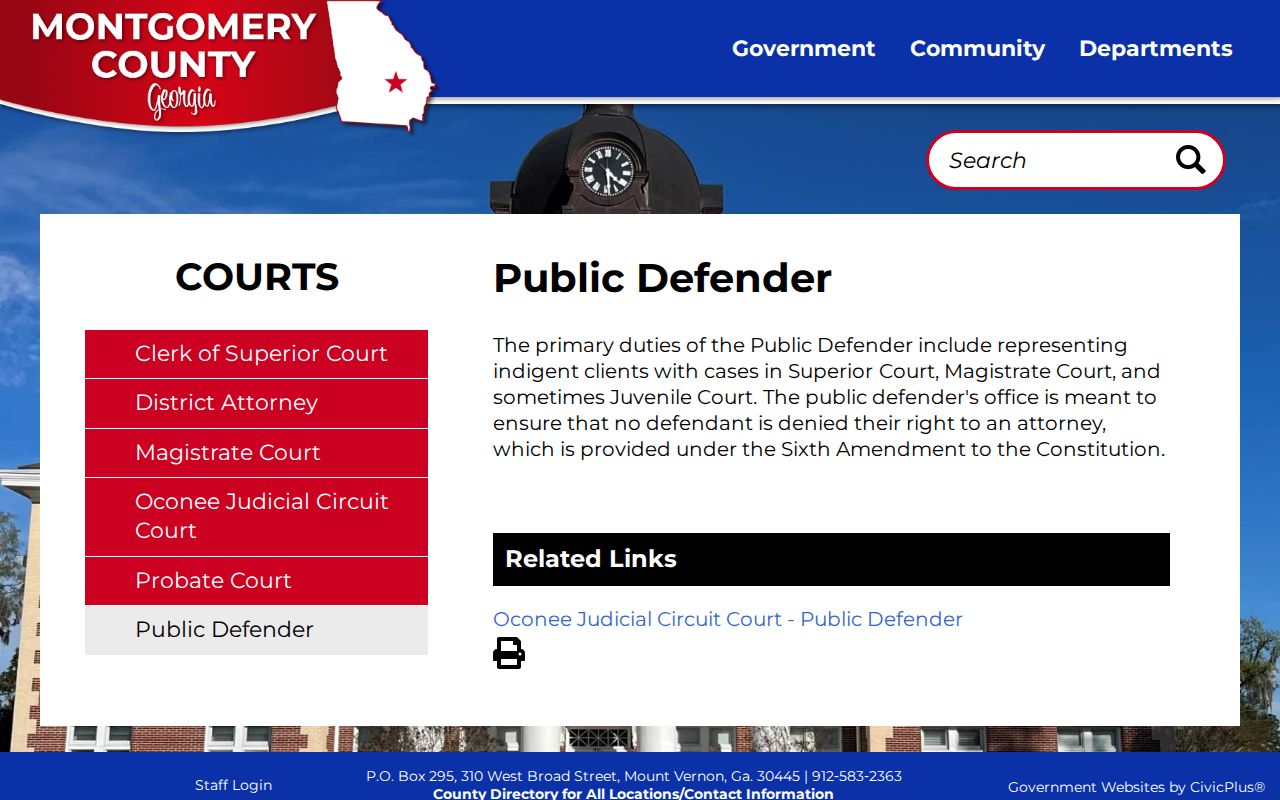
Use current official circuit contact details rather than relying on an older attorney name.
Case Record Access & Restrictions
Georgia policy favors access to public records, but public does not mean unrestricted. Court sealing orders, record restriction, First Offender treatment, juvenile confidentiality under O.C.G.A. § 15-11-700 et seq., victim protections, medical information, Social Security numbers, and security material can limit what Montgomery County releases. Active investigative material may also be withheld under the Georgia Open Records Act.
When only part of a file is protected, ask for segregable public portions. Online redaction can differ from the courthouse file, but neither channel overrides a sealing order. If a case does not appear, give the clerk the defendant's full name, aliases, approximate filing or arrest date, and court. The GSCCCA clerk directory provides an additional official check on the Montgomery clerk's identity and contact details.
Eligible Georgia records may be restricted under O.C.G.A. § 35-3-37, while qualifying court documents may be sealed through the statute's court process. Restriction of a GCIC cycle does not automatically erase every courthouse document. Obtain the judgment before relying on a name-only record or seeking correction.